
How Many Lumens Do You Need on a Bike Light?
By Jeremy Lucas

The short answer: For city riding under streetlights, 200–400 lumens is enough to be seen. For dark roads, plan on 800–1,200 lumens, and 1,500 or more if you descend fast at night. For mountain biking on trails, 1,500 lumens is the minimum and 3,000 or more is better. In daylight, a bright flashing taillight matters more than anything on the front.
That's the quick version. But lumens are only part of the story, and chasing the biggest number on the box is how people end up with a light that blinds everyone and still doesn't light the road well. Here's how to pick the right light for how you actually ride.
What Lumens Actually Measure
A lumen measures the total amount of light coming out of a light. It doesn't tell you where the light goes. Two 1,000-lumen lights can look completely different on the road: one puts a wide, even beam on the pavement 50 yards ahead, and the other makes a bright circle that lights the treetops and the eyes of oncoming drivers.
Three other things matter just as much:
- Beam shape. Is it a round flashlight beam, or a shaped beam with a cut-off on top?
- Beam distance. How far down the road can you see? Better lights list this in meters.
- Runtime at the setting you'll use. Not the maximum runtime on the box.
How Many Lumens Do You Need? By Riding Type
| Type of riding | Front light | Rear light |
|---|---|---|
| Daytime road riding | Optional, a daytime flash helps | 100+ lumens, flashing |
| City commuting with streetlights | 200–400 lumens | 50–100+ lumens |
| Dark roads and bike paths | 800–1,200 lumens | 50–100+ lumens |
| Fast road descents at night | 1,500+ lumens with cut-off beam | 100+ lumens |
| Gravel at night | 1,200–2,000 lumens | 100+ lumens |
| Mountain biking at night | 1,500–3,000+ bar light, plus a helmet light | Optional |
Commuting in town
When there are streetlights, your front light is mostly about being seen, not seeing. 200–400 lumens with a flash mode is plenty. Spend your money on the taillight instead, since most car-bike crashes involve drivers who didn't see the rider.
Dark roads
Once you leave the streetlights, you need to see potholes, gravel and debris early enough to react. At 18 mph, you cover about 26 feet every second. A light that only shows you the next 20 feet isn't enough. 800–1,200 lumens with a decent throw will light the road far enough ahead at normal speeds.
Fast descents
This is where people underestimate what they need. At 35 mph on a canyon descent, you cover more than 50 feet per second. You need both brightness and distance, and you need a beam that doesn't blind the car coming up the hill. This is why I ride with 1,700 lumens and a cut-off beam. The Magicshine EVO 1700 PRO throws light about 205 meters down the road.
Mountain biking
Trails are a different problem. There's no ambient light, the terrain changes constantly, and you need to see wide, not just far. Most night mountain bikers run two lights: a wide flood on the bars and a spot on the helmet that points wherever you look. Bar lights in the 1,500–3,000 lumen range are normal, and serious night riders go much higher. I wrote a whole guide on this: night mountain biking with the MONTEER 12000.
Why the Beam Matters More Than the Number
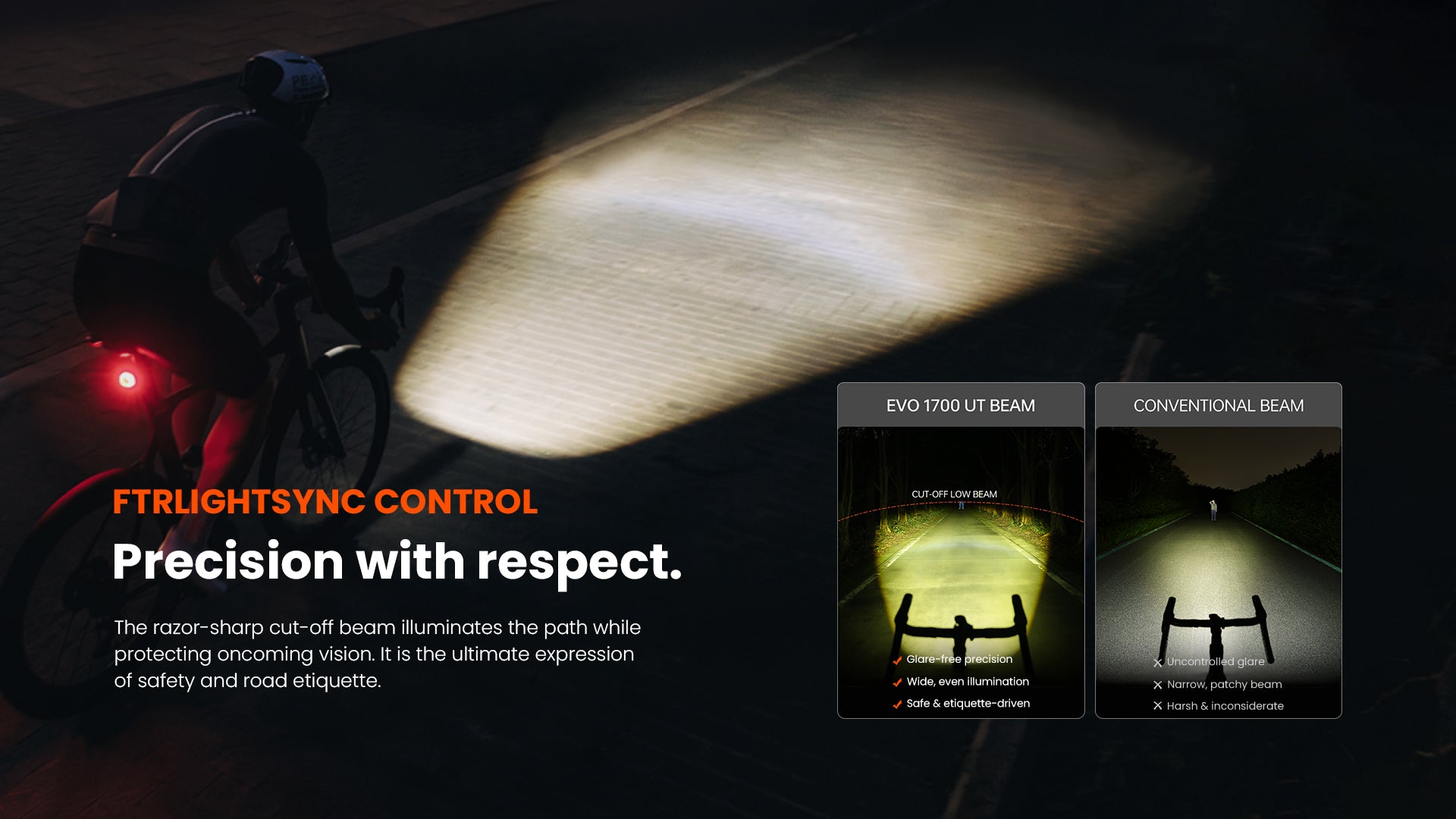
Most cheap high-lumen lights use a round beam. It's bright in the middle, but much of the light goes up and out, where it lights trees and blinds oncoming traffic. Point it low enough to avoid blinding people and it stops lighting far enough ahead.
A cut-off beam fixes this. The top of the beam is flat, like a car's low beams. All the light goes onto the road, where you need it, and none goes into drivers' eyes. German road rules (StVZO) require this kind of beam for bike lights, which is why you'll see "StVZO" on some lights. U.S. law doesn't require it, but if you ride roads with traffic, it's the most considerate and most useful beam you can run.
Both Magicshine EVO 1700 lights use a cut-off beam with a high-beam mode for empty roads. I compared them in EVO 1700 UT vs. EVO 1700 PRO.
Don't Trust the Lumen Number on Cheap Lights
I once bought an $8 light from AliExpress. It died after a couple of charges, and the seller wasn't interested. Lumen claims from no-name sellers aren't tested by anyone, and there's no warranty behind them when the light quits.
Established brands publish realistic numbers and back them with a warranty. Magicshine has been making lights since 1999 and covers its lights for 2 years. That doesn't mean expensive is always better, but it does mean you should be suspicious of a $15 light that claims 5,000 lumens.
Runtime: The Number Everyone Misreads
When a box says "up to 14 hours," that's measured at the lowest setting. At full power, runtime is much shorter. Before you buy, figure out:
- How long your longest night ride is.
- Which mode you'll actually use. Most people run a mid setting and bump to high on descents.
- How often you'll charge. Weekly commuters need more battery than people who charge after every ride.
Then buy a light with headroom. Batteries lose capacity in cold weather, and you never want to find out your light is dying 10 miles from home.
Daytime Lights: The Most Underrated Safety Gear
Here's the part most riders skip. If you ride on roads during the day, a bright flashing taillight is one of the best safety upgrades you can make. Drivers notice a flashing light far earlier than they notice a rider in kit, even a brightly colored one.
For daytime, you want a rear light designed to be seen in sunlight, not just at night. The Magicshine SEEMEE 300 puts out 300 lumens, has a daytime flash mode, and flashes brighter when it senses you braking. I wrote more about it in daytime running lights for cyclists.
What I Run
- Road, night and early mornings: EVO 1700 PRO under my computer, SEEMEE 300 on the seatpost.
- Daytime road rides: SEEMEE 300 on the back, always.
- Night trails: a high-output external battery light like the MONTEER 12000 on the bars.
Questions to Ask Before You Buy a Bike Light
- How dark are the roads or trails I ride?
- How fast do I go at night, especially downhill?
- Does the light have a cut-off beam if I ride near traffic?
- What's the runtime on the mode I'll actually use?
- Is it from a brand with a real warranty?
- How does it mount, and will it work with my computer mount?
- Do I have a good taillight too?
Bottom Line
Pick lumens based on where and how fast you ride, pick a cut-off beam if you share the road, check runtime at the mode you'll use, and don't forget the back of the bike. For most road riders who ride after dark, that means about 1,000–1,700 lumens up front and a bright flashing taillight, day and night.
Want a recommendation for your rides? Text (801) 821-6846 or email support@168velo.com. You can also see every light we carry on our Magicshine USA page.
0 comments